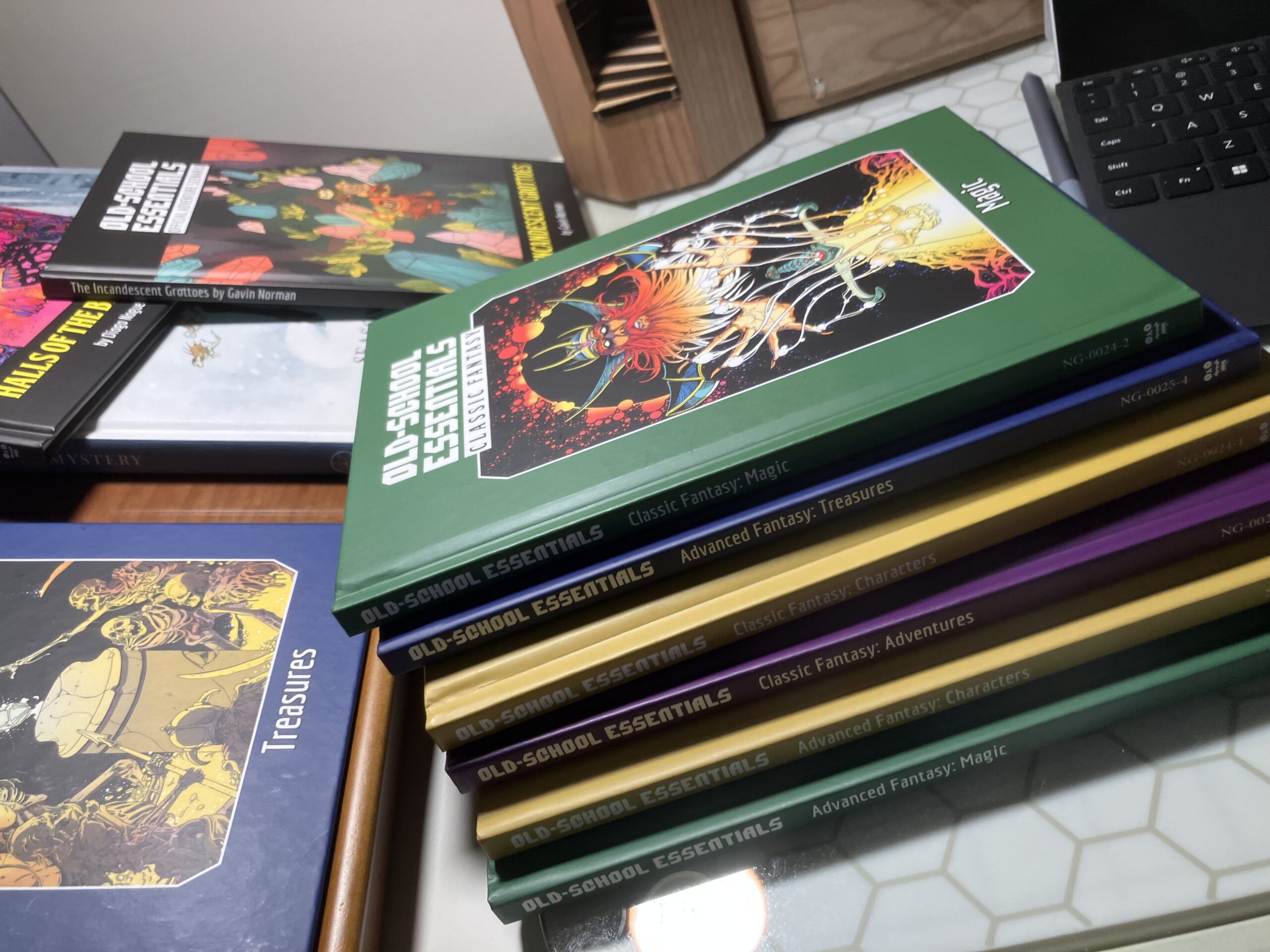
The other night I took my party of characters into the ruined temple in the OSE written adventure called The Incandescent Grottoes.
We didn’t get far. In fact, we only got to the second area before we had to turn back.
In this adventure, you are supposed to have a monster encounter every 2D6 x 10 feet, and that’s exactly as far as we made it. I rolled on the encounter table and had to face three troglodytes, which was perfect because that was the area we had entered, the troglodyte part of the grottoes, where the dead troglodyte is found.
We won without anyone dying, but you have to roll to avoid Poison whenever you melee fight troglodytes, evidently because they smell so bad, and so we took a lot of damage and therefore had to retreat out of the grottoes.
Furthermore, even though the room with the dead troglodyte has crystal grottoes, we couldn’t harvest any of the crystals, the book said, unless we had “proper mining equipment”, which, of course, we did not. I actually think this is a flaw in the adventure design, frankly, because how are you supposed to know you need mining equipment? And where are we supposed to get that? It’s a Level 1 adventure, and the only thing that looks like mining equipment in the Character and Adventure books in the box set is a simple hammer.
Anyway, not even having a hammer, we left.
And this brings me to the topic of this post, which is stakes, and what that means for storytelling and player experience.
This is actually a rather nuanced topic, and I can’t sum up all my thoughts about it at once, so bear with me.
Basically, in my opinion, treasure is not sufficient stakes. For me to engage with the game, that is. I don’t care about treasure.
I know that runs contrary to the spirit of OSR type games, where everyone seems to be enamored of this idea of “emergent storytelling”, where you enter into this big sandbox world, and whatever happens during the game is the story. And evidently what motivates your characters to enter into any dungeon is the promise of treasure, and it’s as simple as that.
Everyone seems to think this is a profound and brilliant idea, superior in every way to scripted adventures.
It’s not.
Look, most stories are stories because that’s the way things happened in the real world, and now they are telling you what happened, and that telling is the story. So I’m not saying that a good story can’t evolve out of simple real world events. Most stories happen that way.
Look at Record of Lodoss War, as a perfect example. Those were just replays of what happened during the game, published in a fan magazine, and they took those replays and turned them into a piece of fiction that became a really successful manga and then anime. All that story from just playing the game.
However, if you watch Lodoss War, you will notice that there is a lot more at stake than simple treasure.
I’m not sure you can have any other stakes with the sandbox approach. And I think that would be fine, if you are playing with a group.
As a solo player, I don’t think it works.
For me, entering The Incandescent Grottoes felt like an interesting experience, sort of like going on a new hike. I think the writing, and the dungeon design, from what I got to see of it, is really top notch. It might even be worth it for me to continue fighting my way through the dungeon just to see the dungeon, and that might be more stakes than the treasure is worth. It would be, actually.
But it’s sort of like playing Fortnite in battle royale mode. It’s kind of fun, but not nearly as much fun as it is when you are playing on a team. Because in the end, if you’re playing Fortnite by yourself, who really cares how well you did? At my age, I can assure you, no one cares. I don’t even care. A younger person might think it matters how good at Fortnite they are. It doesn’t.
So your OSR type adventure experience, played in a group, might be worth something in the end even though the only thing of value in this sandbox world is treasure, because of the shared experience you had playing with others. You don’t actually even need a story. Who said these games have to be about story, anyway? Can’t they just be about the experience?
But as a solo player, I think you need one. You need some reason to do it, you need something at stake.
Partially, I think this is because stories are more personal and more individual. Sure, you might be one of many sitting in an audience in a theater somewhere, or there might be other people sitting on the couch with you in front of the tv, or there might be others in the car with you when you’re listening to a book on tape, but your story experience is your own. It’s a one to one communication.
And I think when you’re alone, that’s what you are craving. With other people at the table, maybe not so much.
That’s the way video game RPGs work. Or at least, the non-MMORPG ones. I never got into the latter, and maybe that’s why. The “MM” in MMORPG stands for “Massive Multiplayer” and those games are just giant sandboxes. They work as sandboxes because they are multiplayer. Me, just playing by myself, never really saw the appeal in them other than the curiosity of exploring the world that the creators designed. Which has its own value, but really can’t hold your attention for long.
So, to sum up my experience so far with Old-School Essentials, I would say that it’s an interesting world, and I like the curated feel to everything, instead of the kitchen-sink approach to world and game building that 5e takes, for example. It’s more coherent and I think stronger for that.
But I might have to write my own adventures for it. And I’m going to have to figure out how to do that and keep it interesting for me then as the player.
PS: As a final word on a related topic, I thought I might say something about “railroading”.
Evidently, railroading is the cardinal sin of TTRPG design. Ever since I started playing these games, which is less than a year now, I’ve heard people talk about this concept of railroading and how it’s synonymous with poor adventure design.
Yea, not really.
Look, if you sit down at the game table and want to just do whatever you want and go wherever you want and have everything in the universe available and open to you, then play an MMORPG. Don’t play Old-School Essentials or 5e.
Why do I say this?
Well, as someone who has only ever been a dungeon master, except for my solo adventures, I can tell you, it’s really hard to DM for that kind of scenario. Almost impossible I would say. And I’ve tried because sometimes it was hard to get the kids I was DMing for to stick to the adventure. Or even the rules.
And I know some would say that there are DMs across the world who pull it off with flying colors. And to that I say, BS. I’ve watched some of these non-railraody “adventures” on YouTube, even on some game designer’s channels, and I have not been impressed with anything going on at the table.
I think all of these people who complain about railroading should try to DM for once, and actually do it for real. Let their players do whatever in the game world they want to do, and see how this works. I bet you it’s the last time they DM.
It could provide some fun, granted. Mayhem might ensue and that mayhem could be good for some laughs. Fine. Great.
But that’s lame, as far as I’m concerned. It’s not something I would ever take part in. I’ve got laundry to do.
There has to be some kind of mission, or purpose to the game. Even in chess, which is a pretty open game in terms of player decisions, there is at least the goal of capturing the king. Even in solitaire, there is at least the goal of creating some kind of order out of chaos. In golf, where you can take whatever route you want, you still eventually have to get the ball into the hole.
If you don’t have some sort of purpose to the game, it’s not a game.
What you are playing is make-believe.
And while all RPGs of any type have an element of make-believe to them, and make-believe can be fun, that shouldn’t be all there is. And if that means the adventure design has to “railroad” you toward something, then good.
Chess has the board, golf has the trees, solitaire has a limited pile of cards and a limited number of turns. All railroads.
Thanks for reading.