Hello.
I thought in this post I would go through some of the advice from Solo Game Master’s Guide about how to set up a scenario using the Arkand expansion from Dragonbane.
I had originally backed the Arkand and the Book of Magic campaign months ago, one of the first things, if not the first, I ever backed on a crowdfunding platform, and have had both books for awhile. I’ve flipped through Arkand before, but didn’t want to read too deeply into it because it says that it’s for the GM’s eyes only. So obviously, there are spoilers.
Not really knowing how to approach that, I put it aside. Now, however, I think I can delve into the actual pages using the techniques from the Solo Game Master’s Guide, and not necessarily ruin everything.
So that’s what I did, and I thought it would be more interesting to see how some of these ideas are applied in an actual test case than to just read my ideas about the book.
So, one of the main premises of the book is that solo RPGing is about stories. I know the word “story” makes some people in the TTRPG community nervous, but she’s not saying that all TTRPG game sessions are about story, just that solo RPGing is. And I totally agree with her about that. See my post about The Incandescent Grottoes for a discussion on that topic.
And so a lot of the book deals with how to find stories and what makes them work in an RPG format.
So, she begins at the beginning: where do we find inspiration for narratives?
And she has four different categories for these types of resources. I’m only going to talk about the first two, suggestive resources and generative resources, because these are the most useful at the beginning.
A generative resource is something you repurpose and throw into your RPG world. So an example of this would be just looking at the spines of your books in your library and picking random words to use for names or something like that. Ian Fleming said that’s how he came up with the name James Bond, because there was a horticulture book on his shelf or something like that and that was the author’s name. I personally think that’s apocryphal, but it’s an example of what we are talking about here.
Suggestive resources are a little bit different. She writes, “Think of them as something you are given as a starter, and take it from there.” (p.33) These could include such things as maps, RPG cards of various types, minis, etc.
Obviously, the Arkand expansion itself would be a suggestive resource then. For the record, she’s not assuming you already have a module or something like that. The book is written from the point of view of starting from scratch, just in case that’s all you have (maybe some dice too). If you already own a setting book like Arkand and want to play in that world, then start there. Most of the work has been done for you then, and that’s what you paid for. But I still think you’re going to have to draw on things from outside that world if you’re going to write your own adventures, hence, the generative resources.
So I began with these two ideas, and also one other, which she calls “anomalies”. An anomaly is something that sets one RPG rule set apart from another, some way the design team innovated the conventions of the genre. Obviously, this advice only applies if you are starting from a preexisting rule set. Which I am, here, with Dragonbane. The reason to look for anomalies isn’t really spelled out in the book. I think it’s just that if you are looking for ideas to spark inspiration, then that’s a good place to start. Which seems like sound advice.
And she gives an example of how this would work using the Starfinder TTRPG. I’m going to show you how it would work using Dragonbane.
If you asked any person, any person at all, what’s the most anomalous thing about Dragonbane, the thing that stands out as most unique, and they will most certainly say the mallards. As in, the ducks.
You can play as a duck in Dragonbane. Of course, you can play as an elf or a human, or a dwarf, or a halfling, but, this being Swedish and therefore slightly goofy (but in a good way, think ABBA), you can also play as a duck.
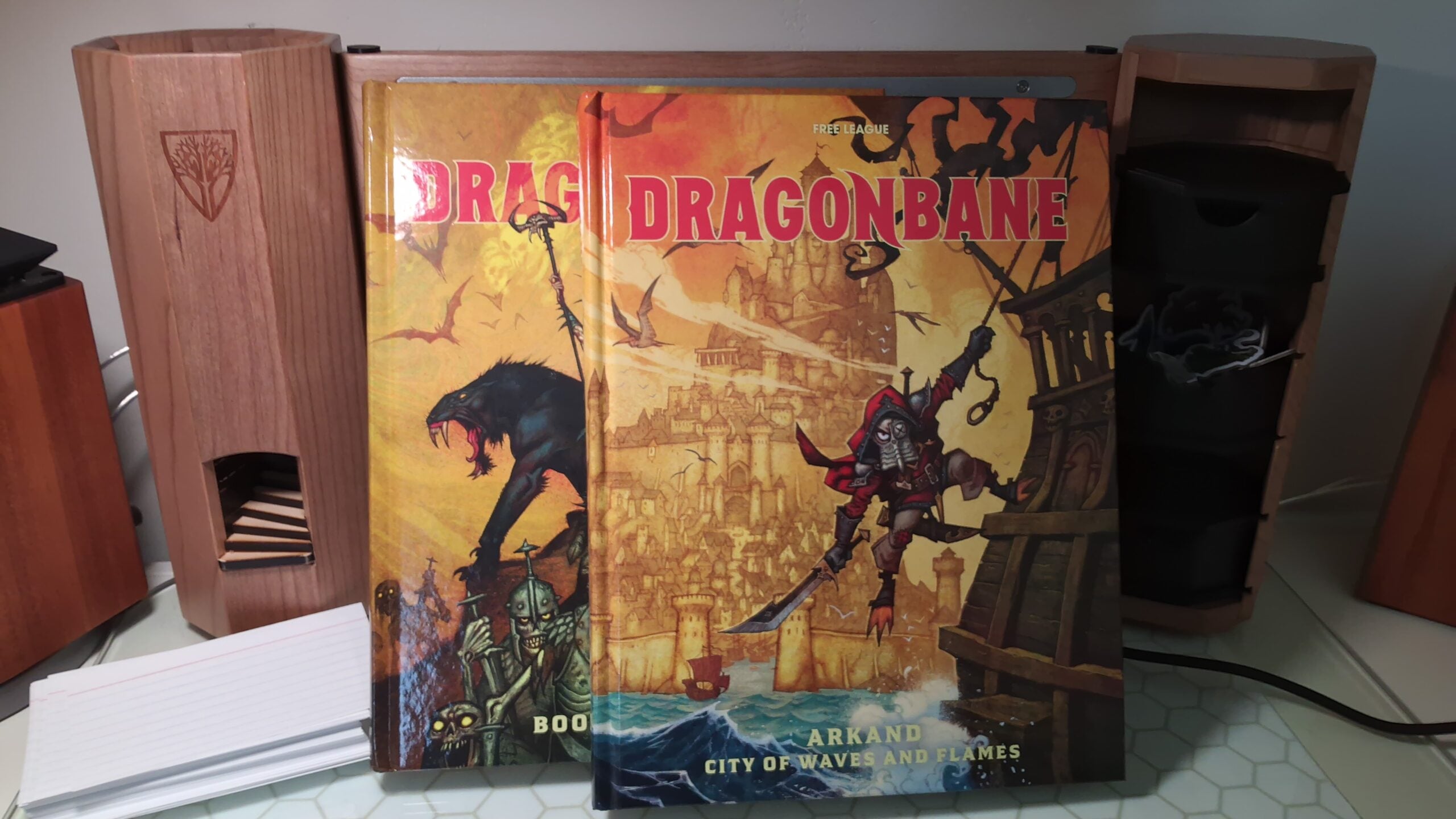
It’s such a trademark identifier that the rules booklet for Dragonbane in the Starter Set features a mallard assassin on the cover, and the Arkand expansion itself has a mallard pirate on its cover as the only figure, with the city behind him.
So of course my main character is going to be a mallard. And he falls in love with a waitress in a sailor’s bar, let’s call her, ahem, Brandy, and she is part swan-maiden (a “monster” out of the bestiary), and can therefore turn herself into a swan.
But let’s back up.
In the introduction to the Arkand expansion, or in the first few pages, which I am using as a suggestive resource, it gives the history of Arkand. Arkand is an island that was formed from the seismic upheaval caused from the dragons sealing away the demons underneath the Sea of Dreams in a great battle long ago. Rocky islands formed on the easternmost part of the known world near the seal and those rocky islands eventually became Arkand, the City of Waves and Flame.
This is important, because the seal on the bottom of the ocean floor never settled, and the book is quick to point out that it still pulses with energy, as if the demons are pushing against it. The dragons have long since left, betrayed by their human allies, and so there is no one left to guard the seal.
Our hero (don’t have a name yet), is a young mallard who sails into the port of Arkand in search of his fortune, and this is where I’m just going to write what happens and hopefully you can follow along and see what is suggestive and what is generative as I go.
So, of course, his little boat that he has, not much more than a dingy with a cabin, is called the Orphalese. Because, of course it is.
And what would you do, newly arrived in a foreign city and seeking your fortune? You go looking for a job.
In Arkand, everything is controlled by six guilds, such as the Guild of Waves for sailors and the Guild of Hammers for Artisans, etc. And the only way to actually be a citizen of the self-governing city is to belong to one of the guilds. Everyone else is basically a second-class citizen.
So, of course, our hero tries to join one of the guilds.
And here is our first point where our campaign paths might diverge. In one scenario, he happens to make it into one of the guilds, in which case the story unfolds quiet differently, which I haven’t quite worked out, but ultimately arrives at the same climactic battle.
Otherwise, and this is the scenario I want to explore, he doesn’t make it into one of the guilds. And I would have to determine this with some task or test that he would possibly fail. Like an entrance exam of some sort, and let fate and dice decide.
But let’s assume he doesn’t get in.
In Arkand, the City Watch is a part conscription, part volunteer, part professional police force. It is manned by members of the Guilds, whose members are forced into service for a time whether they want to be or not, hence the conscription, or who can volunteer.
Alternatively, they can pay for a substitute to take their place. Various second-class citizens turn into career members of the City Watch by constantly being hired as substitutes. Hence, the professional aspect of the City Watch.
Our guy is going to hire himself out as a substitute.
This way, he is going to learn about the underworld of the City of Arkand, before going out on his own as a consulting detective, which is ultimately what I want him to be and the scenarios that I would want to play.
Looking around my living room, I notice my Miami Vice boxed set blu-rays, and decide that he is going to live on his little houseboat out in the harbor. Maybe he always wanted to live on a houseboat like his favorite hero from detective fiction, which in this world we’ll call Sonny Mcgee (I know. But in the Arkand expansion lore Arkand itself was first inhabited by a mallard pirate captain named “Blackbill”, so I think it’s okay.)
This would make sense. On an island city, there is bound to be smuggling (the intro even mentions a “Wavemaster Brigador” interrogating someone suspected of it), and that would have to pass through the harbor. So it would be a good place for a detective to hide out, assuming he isn’t discovered.
And why would you need a detective if you already have the City Watch? Well, first of all, there are certainly going to be cases where one guild doesn’t want another guild to know about something, and the City Watch is a democratic institution populated by members of all the guilds. So they would definitely need someone from the outside to keep it secret. Also, the City Watch, like any police force, isn’t going to investigate everything someone wants investigated.
Anyway, he frequents a sailor’s bar called The Bridges. I got this name because on the map of the Harbour from the Arkand expansion, the lower right-hand part of the map has no places of interest already named. It’s just sort of a map of this part of the city with anonymous buildings and streets and canals. If you look at it closely though, there is a point where three bridges come together and there is a fairly large building there at the intersection with what looks like an attached patio. So I’m just going to make that building a sailor’s bar and The Bridges sounds like an appropriate name.
Actually, probably a really good name which plays upon the investigative motif of making connections.
This is where he meets the fine girl Brandy, and falls in love with her.
Eventually, he uncovers a plot to free the demons from their underground prison. Maybe he discovers that it has already broken a bit, and there are demons loose in the city. Maybe, and this would be the most narratively rich possibility, he is somehow inadvertently responsible for it.
I don’t need to know the details of how that happens just yet, only that it seems like the most logical way to end a campaign in the city. I mean, the book itself suggests it to you in the first few pages, and it’s pretty obvious that they are pointing out the seal on the ocean floor as a potentially climatic point of interest. They hint at it, but it’s hard to miss.
So the demons break out.
Now, according to the lore of Arkand, there used to be these warriors called Dragon Riders, back before the dragons left the city. Our hero decides that the only way to defeat the demons and reseal them beneath the waves, to save the woman he loves of course, is to become a Dragon Rider and lead some dragons back to Arkand, Avatar style.
But that means he has to leave Arkand and go find a dragon somewhere, back in the normal world of Dragonbane. So he set’s sail…
So as you can see, this “narrative direction” as the Solo Game Master’s Guide calls it, just grew pretty naturally from only a few resources, and led to a basic idea for a campaign that could take months to play. It wasn’t particularly hard to do, but this is all you really need to get started.
The book goes further in to how you actually play some of these scenarios out, using tables and oracles and all that, but the first step is to figure out what you are actually doing in this world and why you are doing it. And it’s as simple as what we did above.
Anyway, hope that was an interesting example. I’m actually going to play this and use some of the gameplay advice from the book and report back.
Thanks for reading.